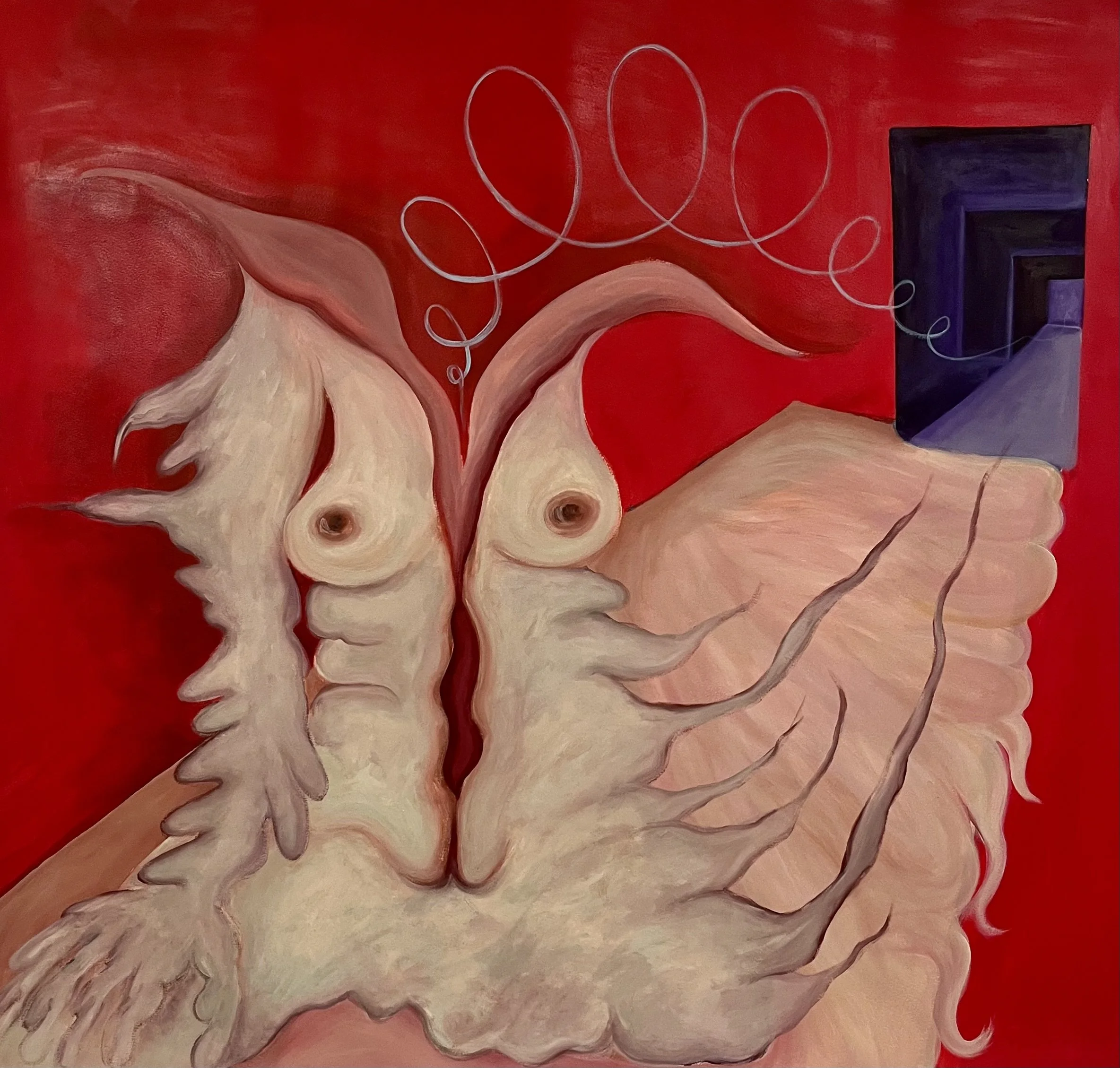
These paintings have served as field journal entries in examining the relationship between trauma and perception, body and mind, trying to understand the points of connection between emotional and physical pain and discomfort. These paintings aim to explore the results of the body’s exposure to violence. Through the use of elements of surrealism and abstraction in forming psychological "landscapes", the goal of the paintings is to describe the internal processing of violent and traumatic experiences that happen to the body, having the figure(s) be the grounding point in physical reality. By extension, I am interested in studying psychological phenomenas that lead to the disruption and distortion of external reality and perception of the self. As a result, these paintings contain themes of isolation, dissociation, paranoia, and disorder.
I am interested in encountering the process of painting through automatism.
AUTOMATISM: performing actions without conscious thought or intention.
In art making, this would attempt to avoid “intentionality” in art production, instead relying on subconscious associations (psychological) and mechanical impulses (physiological).
Automatism, in respects to the process of art making, may provide insight into the ways the mind and body create flows of connection, and how our experiences in the world imprint on our bodies and minds in the process of assigning symbols and meaning in our encounters.
I have come to understand this approach to art making through encountering Deleuze and Guattari’s theory of ‘The Body Without Organs’, as described in Anti-Oedipus. ‘The Body Without Organs’ serves as an idea, form, or force that drives a “machine”, or the point of connection or relationship between two entities involving a tangible or observable process that is carried out.
Examples may be demonstrated as:
Idea —> Mind of Artist
Mind —> Brain
Brain —> Hand
Hand —> Paintbrush
Paintbrush —> Paint
Paint —> Canvas
and so on…
Questions:
How do our physiological (of the body) responses to our environment (external reality) through the senses affect our mental processes (psychological landscapes)?
Where do ideas come from or live? How do we create symbols and images of these ideas? How do ideas transfer into an individual’s conscious mind? How does that connect to the body?
How does the mind and body retain memories of physiological or sensory experiences? How does the mind and body accommodate encounters with violence and the experience of trauma?